Medical and technical equipment
Laboratory Equipment and Sensitive Instrument Logistics
Laboratory equipment and sensitive instruments need freight planning around condition, calibration risk, packaging status, access, timing, site readiness, and receiving coordination.
Article guide
What this article helps plan
A business shipper needs logistics support for laboratory equipment, sensitive instruments, diagnostic devices, monitors, carts, or technical equipment moving into a lab, demo room, clinic, or facility.
- Who needs to be aligned before pickup or delivery.
- Which product details affect the freight path.
- Where timing, access, condition, and final placement can create risk.
Laboratory equipment and sensitive instruments need more planning than ordinary commercial freight. The product may include calibrated components, screens, sensors, glass surfaces, fluid paths, delicate housings, internal mechanisms, software-dependent parts, or accessories that need to arrive in usable condition.
Why this product needs planning
For laboratory equipment manufacturers, diagnostic device companies, technical equipment suppliers, medical equipment brands, research facilities, distributors, installers, facility managers, and project coordinators, the shipment is often tied to a specific receiving environment. That could be a lab, clinic, demo room, training facility, research center, university, medical office, technical workspace, or installation site.
Details to confirm before pickup
- Product dimensions, weight, finish sensitivity, and packaging condition.
- Pickup and delivery addresses, access notes, receiving contacts, and appointment windows.
- Whether the delivery requires inside placement, stairs, elevators, dock access, or room-ready handling.
Destination and receiving details
The first step is identifying what is moving and how sensitive it is. A diagnostic analyzer has different handling needs than a microscope, monitor, cart, benchtop instrument, test device, calibration unit, sample processor, technical case, accessory kit, or sensitive cabinet. Dimensions, approximate weight, packaging status, accessory list, and handling restrictions should be clear before pickup.
How HHX helps coordinate the move
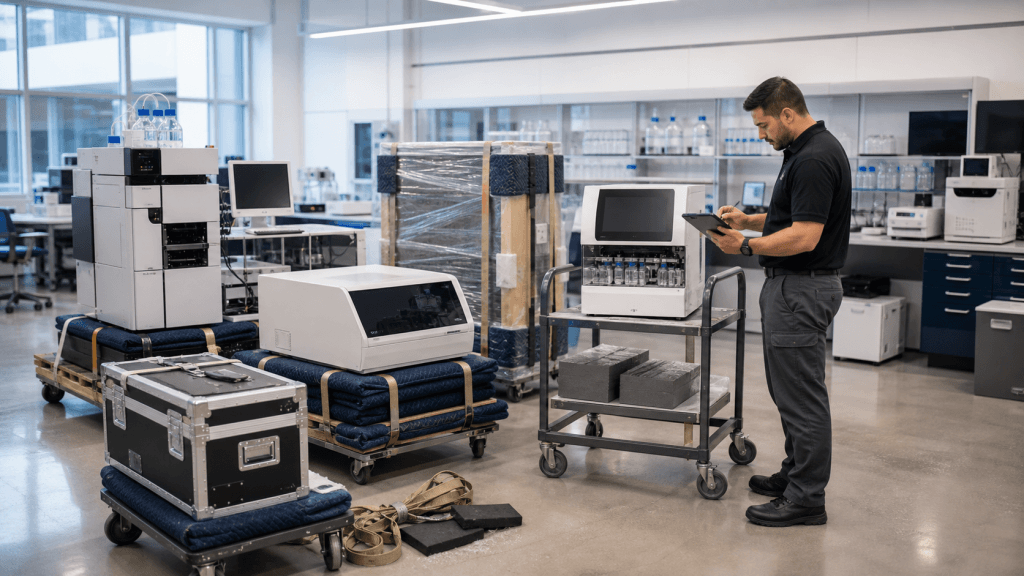
Packaging condition should be documented. Some instruments ship in manufacturer crates or reusable cases. Others may be blanket-wrapped, palletized, boxed, or staged on carts. If the equipment has calibration risk, fragile panels, glass, moving parts, or sensitive components, the packaging method should match the product and the route.
Condition visibility matters. Product photos, packaging photos, serial-number photos where appropriate, and notes about existing wear help reduce confusion at delivery. Screens, doors, panels, tubing, cartridges, ports, trays, wheels, handles, and accessories should be visible enough to identify what is being moved.
Access can be the most practical risk. Laboratory and technical spaces often involve elevators, narrow corridors, controlled entries, loading docks, badge access, service doors, clean-room transitions, threshold changes, finished floors, or limited receiving hours. A device may be small enough to fit through the door but still require careful routing to avoid impact, vibration, or staging problems.
Site readiness should be confirmed before the shipment arrives. If the room is not ready, benches are not installed, power is unavailable, floor space is blocked, or the receiving team is not present, sensitive equipment may be staged in the wrong place. That increases handling and creates avoidable risk.
Receiving expectations should be separated from technical installation. Freight coordination may involve delivery to a dock, receiving room, lab doorway, demo area, or final room depending on the agreed plan. Calibration, validation, software setup, electrical connection, plumbing, gas connection, network setup, and technical startup should be assigned to qualified parties and not assumed as part of freight delivery.
Timing can affect the larger project. Laboratory equipment may need to arrive before training, a product demo, research launch, inspection, facility opening, technician appointment, clinic setup, or installation window. If the shipment is early, the site may not have secure staging. If it is late, technical teams may lose their planned schedule.
HHX should treat these shipments as high-care product moves, not generic boxes. Some instruments can move through standard freight paths when packaging and receiving are straightforward. Others need more careful coordination because of value, sensitivity, documentation, appointment timing, air freight needs, or facility access.
For business shippers, the useful details are practical: equipment type, dimensions, approximate weight, product photos, packaging photos, crate or case status, accessory list, handling restrictions, pickup address, delivery address, receiving contact, dock status, interior access notes, target date, appointment window, and final placement expectation.
Before requesting support, shippers should gather product photos, packaging photos, dimensions, approximate weight, crate or case details, accessory list, handling notes, sensitivity notes, receiving contact, dock information, interior access notes, site readiness notes, target date, appointment window, and any installer or technician coordination notes. Those details help HHX discuss a freight path that fits the instrument and the receiving environment.
Next step for shippers
Send the shipment details before the freight path is assumed.
HHX can review product dimensions, access notes, timing, packaging, and delivery requirements before the shipment is routed.
Contact HHX