Commercial equipment and fixtures
Retail Display Fixtures and Branded Product Installations
Retail display fixtures and branded product installations need freight planning around finish protection, piece count, site access, receiving windows, assembly readiness, and customer-facing presentation.
Article guide
What this article helps plan
A business shipper needs logistics support for retail display fixtures, branded product shelving, glass cases, signage panels, product pedestals, or showroom fixtures moving into a store, pop-up, showroom, mall, venue, or customer-facing space.
- Who needs to be aligned before pickup or delivery.
- Which product details affect the freight path.
- Where timing, access, condition, and final placement can create risk.
Retail display fixtures are usually delivered into spaces where appearance matters immediately. A showroom, pop-up, mall store, boutique, trade venue, brand activation, gallery retail area, or product launch space may be unfinished from a construction standpoint, but the fixtures still need to arrive clean, protected, and ready for the next team.
Why this product needs planning
For retail fixture manufacturers, branded product companies, showroom teams, display fabricators, experiential retail agencies, merchandising teams, project managers, installers, and commercial receivers, the shipment is not just a set of crates. It is part of the customer-facing environment.
Details to confirm before pickup
- Product dimensions, weight, finish sensitivity, and packaging condition.
- Pickup and delivery addresses, access notes, receiving contacts, and appointment windows.
- Whether the delivery requires inside placement, stairs, elevators, dock access, or room-ready handling.
Destination and receiving details
The first step is identifying what is moving. Retail fixture shipments can include glass display cases, illuminated shelving, modular wall systems, product pedestals, cash-wrap pieces, apparel racks, signage panels, branded display towers, acrylic components, millwork, counters, drawers, cabinets, floor fixtures, hardware kits, and boxed accessories. Each piece may have a different finish, packing method, and handling risk.
How HHX helps coordinate the move
Piece count should be clear before pickup. A retail project may include a mix of large finished fixtures, fragile glass, loose shelves, hardware kits, lighting components, panels, trim, and branded inserts. If accessories are not documented, they can be missed, separated, or delivered without the parts needed for setup.
Finish protection matters. Retail fixtures often have painted faces, wrapped panels, glass, acrylic, metal trim, lighting channels, wood veneer, laminate, stone tops, mirrors, or branded surfaces. Scratches, dents, chipped corners, fingerprints, and pressure marks can affect whether the fixture is acceptable on the sales floor.
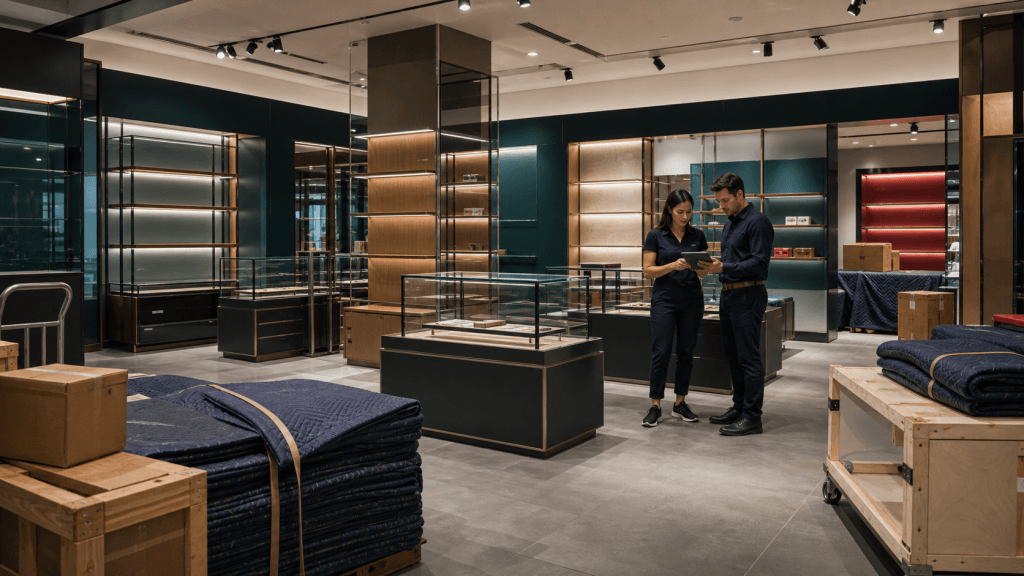
Packaging status should be visible. Some fixtures travel in crates. Others are blanket-wrapped, foam-protected, strapped to carts, palletized, or boxed in groups. Product photos and packaging photos help identify whether the freight can move through a standard path or needs more careful handling.
Site access can change the delivery plan. Retail spaces may involve mall loading docks, freight elevators, service corridors, security checkpoints, restricted receiving hours, after-hours access, narrow storefronts, polished floors, escalator restrictions, parking limits, or contractor-controlled entry. A fixture may fit through the front door but still require a specific delivery path.
Receiving windows are often tight. Brand launches, store openings, remodels, merchandising resets, trade events, and pop-up activations can require delivery during a narrow window. If the shipment arrives before the site is ready, there may be nowhere safe to stage it. If it arrives late, installers and merchandising teams may lose their scheduled setup time.
Assembly and installation responsibilities should be separated from freight delivery. HHX can help coordinate the move and the delivery details, but attachment, lighting connection, anchoring, leveling, merchandising, graphics installation, and final retail buildout should be assigned to the correct project team. The freight plan should make those responsibilities clear before the shipment arrives.
Condition documentation helps everyone. Before pickup, shippers should capture fixture photos, finish details, packaging photos, crate labels, piece counts, glass or acrylic notes, hardware kit details, and any known handling restrictions. At delivery, those details help the receiver confirm what arrived and what still needs to be staged.
HHX should treat these shipments as high-care finished product moves. Some fixtures may be suitable for LTL or FTL when packaging and receiving are straightforward. Others need higher-touch coordination because the product is fragile, expensive, brand-sensitive, or tied to an opening date.
For business shippers, the useful details are practical: fixture type, piece count, dimensions, approximate weight, product photos, packaging photos, crate or blanket-wrap status, glass or acrylic notes, accessory list, pickup address, delivery address, receiving contact, dock details, interior access notes, target date, appointment window, and final placement expectation.
Before requesting support, shippers should gather product photos, packaging photos, dimensions, approximate weight, piece count, crate status, finish notes, glass or acrylic notes, accessory list, receiving contact, dock information, interior access notes, site readiness notes, target date, appointment window, and any installer or project-manager coordination notes. Those details help HHX discuss a freight path that fits the fixtures and the receiving environment.
Next step for shippers
Send the shipment details before the freight path is assumed.
HHX can review product dimensions, access notes, timing, packaging, and delivery requirements before the shipment is routed.
Contact HHX